
Best 2026 Wedding Dress Trends for a Church Venue
If you are considering a church venue for your wedding ceremony, your dress search comes with a natural filter that most 2026 trend guides never apply. The question is not simply which silhouettes are trending this season. The question is which of those trends were made for a space with vaulted ceilings, stained glass light, and architectural detail that does visual work around you.
Here’s a guide for staying on trend while also choosing a wedding dress that not only complements you, but also your surroundings throughout your wedding day.
Fashion Week Wedding Dress Trends for a Church Setting
Wedding dresses that translate best inside a formal church setting are those with vertical structure, movement, and a visual presence that matches the scale of spaces with high ceilings.

The 2026 runway has delivered an exceptional range of exactly those styles. The season's three strongest directions for a church bride are structured corsetry, sculptural surface embellishment, and soft sheer layers. Each works with a classic setting for different reasons, and helps narrow your choices before a first boutique appointment.
Corsetry and the Basque Waist
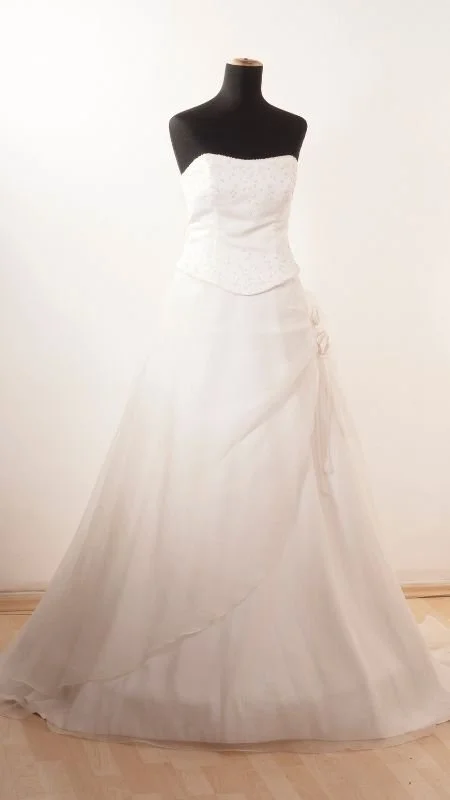
At NYBFW Spring 2026, corsetry appeared as the foundational construction principle of the season, documented by WWD across virtually every collection on the schedule, with designers building everything from sleek columns to full ballskirts over structured boned foundations. For a church ceremony, a corset bodice carries specific logic: its vertical lines echo the height of the space rather than working against it. A basque waist, with its pointed V shape at the front waistline, draws the eye upward through the silhouette the same way a vaulted ceiling draws the eye upward through the room.
3D Florals in Stained Glass Light

At Kaleidoscope Weddings and Events in Pierceton, Indiana, our stained glass window faces west. During the venue's ideal ceremony timeframe, from the afternoon hours into early evening, the light shifts through that glass and settles across the ceremony area as a warm, living glow. Hand-applied dimensional fabric petals catch that light at multiple angles simultaneously, creating depth that changes as the bride moves through the space. That effect cannot be replicated with flat embroidery and will not reveal itself in any fitting room. The "modern Renaissance" aesthetic Grace Loves Lace identified as the defining spirit of the 2026 season, drawing on Victorian and Baroque ornamentation alongside contemporary silhouette, translates inside a historic church with a naturalness that feels almost inevitable.

Sheer and Draped Silhouettes
Sheer layers and draped silhouettes transmit light rather than reflecting it. In a space lit by warm stained glass light in the late afternoon, a bride in a chiffon overlay or a sheer-paneled bodice appears luminous from within rather than simply illuminated from above. Designer Michelle Aznavorian described the 2026 draping direction as bringing "movement, softness and dimension to gowns that feel both contemporary and timeless," with brides able to expect "soft folds that skim the body, cascades of silk that ripple as the bride moves.” In a vaulted church setting, those cascades read at a scale a room with lower ceilings simply cannot provide.
Detachable and Convertible Gowns: One Dress, Two Moments
Versatility became a genuine design priority in 2026 bridal collections. Kaleidoscope’s venue offers separate spaces for the reception and the ceremony, and for a bride who wants unique celebrations with the ease of one location, it is one of the most practical trends of the season. Monique Lhuillier's Spring 2026 collection built the convertible concept into its a premise, presenting detachable overskirts, structured jackets, and opera-length gloves designed to give a bride two completely distinct silhouettes within a single gown. The ceremony version carries the drama and formality that a church setting calls for. The reception version, once layers are removed, brings ease and movement to the celebration that follows.
Kaleidoscope transitions ceremony into reception within the same beautifully restored space. A convertible gown marks that shift naturally, giving the room a different energy for each part of the day without any dress change required. The space does the architectural storytelling throughout; the gown simply changes its chapter.
Bridal separates extend the concept further still, allowing a bride to mix a corset bodice with a contrasting skirt, or a structured top with flowing tulle layers, to assemble a look that exists nowhere on a rack and belongs entirely to her (Source: Lovely Bride). The 2026 runway has made separates more wearable than in any previous season by presenting corset tops, embellished overskirts, and layered tulle skirts as genuinely designed components rather than afterthoughts.

What About Minimalism in a Historic Space?
Minimalism is one of the most confident and most underestimated directions of the 2026 bridal season, and it translates to a historic church setting with a specific elegance that maximalist gowns sometimes cannot match.
The reason has everything to do with what the venue already provides. A restored historic church with stained glass, carved architectural detail, and vaulted proportions is already a fully realized visual environment. A sleek satin column or a structured crepe silhouette placed inside that frame does not compete with the setting. It anchors it. The venue's detail becomes the embellishment. The bride's silhouette becomes the composed center of a photograph the architecture surrounds and supports.
KYHA founder Kyha Schott told Refinery29 that "minimalism isn't going anywhere," and that a cultural moment is underscoring just how powerful a perfectly restrained gown can be. The 2026 collections answered that position with Italian Mikado fabric appearing across collections from Elie Saab, Sareh Nouri, and Renhue at NYBFW Spring 2027, chosen for its structural shaping combined with a luminous, fluid sheen. This is not flat, unadorned minimalism. It is restraint built from fabric that carries presence entirely on its own.
Color, Veils, and the Details That Finish the Look in 2026
Every silhouette direction covered above can be extended or redirected by the finishing details a bride chooses. The 2026 season has strong positions on both color and veils, and both are worth factoring in before boutique appointments begin.
Is White Still the Standard in 2026?
Ivory, champagne, and warm off-white have been steadily replacing stark white as the dominant bridal palette, for both visual and practical reasons. Warmer tones photograph with greater depth against most skin tones and carry more warmth in filtered natural light settings. For a bride drawn to a more intentional departure, the 2026 season made room for color in a range of expressions. Harris Reed's Autumn/Winter 2026 show introduced color through the veil rather than the gown, pairing white lace gowns with vivid blue, green, and pink veils for an unconventional look that preserves the formality of the ceremony while adding a note of personal statement. Galia Lahav and Monique Lhuillier both introduced crimson florals and lace embellishment for brides ready for a committed color moment.
Best Veil Trends of 2026 Worth Knowing
The two veil directions defining the 2026 and 2027 bridal seasons are the birdcage and the Mantilla, both representing a deliberate return to intentional bridal accessories after years of the minimalist no-veil direction.
The Knot's editors at NYBFW Spring 2027 described the Mantilla, the circular Spanish-style lace headcovering, as having an overwhelming presence across multiple collections, chosen for the sense of grace and ceremony it adds to the full look. The birdcage veil appeared at NYBFW Spring 2026 in collections from Monique Lhuillier, Ines Di Santo, and LEIN in collaboration with milliner Gigi Burris, described as the vintage style that elevates the idea of a miniature veil into something with the personality of a chic chapeau.

The pairing principle worth carrying into your boutique appointment: heavily embellished or 3D floral gowns pair more naturally with the structured personality of a birdcage veil, which adds character without multiplying surface detail. Minimalist or draped silhouettes can absorb a full Mantilla or a cathedral lace veil without either piece losing its impact. Bringing veil thinking into the same conversation as silhouette selection, rather than treating accessories as a separate shopping category, consistently produces the most cohesive final look.
The One Detail Worth Knowing Before Your First Appointment
If there is a single structural term worth researching before you start trying on gowns, it is the basque waist. Maggie Sottero identifies it as a V-shaped dip at the front waistline that elongates the torso and accentuates the waist, a couture detail with centuries of history that returned to the 2026 runway with unusual force. Google searches for "basque waist wedding dress" grew 250% in 2025, reflecting how quickly brides in the research phase have made it the silhouette detail they return to most consistently on their inspiration boards.
Its practical value for a church bride is clear. The basque waist works across every skirt shape: the column, the A-line, and the full ball gown. The pointed front waistline creates vertical extension through the bodice regardless of what the skirt does beneath it, which means it pairs naturally with everything from a sleek minimalist silhouette to a dramatically embellished cathedral gown. Walking into a first boutique appointment knowing you want to try a basque waist is the equivalent of arriving with a clear brief rather than starting from scratch.
FAQ: 2026 Bridal Trend Questions Answered
What are the biggest wedding dress trends for 2026?
The dominant directions from the 2026 runway are structured corsetry and the basque waist, 3D floral and sculptural surface appliqués, sheer and draped silhouettes in luxurious fabrics, detachable and convertible gowns designed for multiple looks in a single day, confident minimalism in structured materials like Italian Mikado, and a renewed investment in expressive accessories including birdcage veils, Mantilla veils, and statement opera-length gloves. What distinguishes 2026 as a season is how genuinely these directions cover different tastes simultaneously, giving every bride a starting point that belongs to her rather than a single prescribed look.
Are corset wedding dresses still popular in 2026?
Corset wedding dresses are more than popular in 2026. They form the structural backbone of the entire season. What began as visible boning as a fashion detail has evolved into the foundational construction principle across virtually every major collection at NYBFW, applied beneath minimalist columns, romantic ball gowns, and sheer sculptural layers alike. The corset is no longer one trend among many on the 2026 runway. It is the construction language the season speaks.
What is the difference between a basque waist and a drop waist wedding dress?
A basque waist creates a pointed V at the front center of the bodice, producing a defined focal point at the waistline that elongates the torso above and transitions into the skirt below. A drop waist extends the bodice lower, past the natural waist and toward the hip, creating a longer torso line with a skirt that releases at hip level. Both are 2026 trends serving different proportional goals: the basque waist suits brides who want to define the waist and create vertical length through the torso, while the drop waist suits brides who want a relaxed, low release point and a silhouette that flows from the hip rather than the waist.
Do 2026 wedding dress trends work for a church ceremony?
Yes, and 2026 is one of the most church-compatible bridal seasons in recent memory. Structured corsetry echoes the formality and vertical architecture of a historic church. Sheer and draped silhouettes capture filtered stained glass light and move beautifully through a vaulted space. 3D floral and sculptural appliqués interact with colored light in ways that no other venue type can replicate. Minimalist gowns in structured luxury fabrics allow a historic venue's architectural detail to carry the visual weight of the ceremony while the bride's silhouette anchors the frame. The season's convertible and multi-look options also suit venues where ceremony and reception share the same beautifully restored space.
What bridal accessories and veil styles are trending alongside 2026 gowns?
The leading accessory trends of 2026 are the birdcage veil, the Mantilla, oversized statement bows, embroidered headbands, and opera-length gloves. The broader accessory direction of the season favors deliberate, personal choices that make a statement rather than simply finishing the look. For a church bride, the most useful framing is to treat the veil as part of the silhouette conversation rather than a separate category. A birdcage veil pairs naturally with embellished or sculptural gowns, adding personality without layering detail onto detail. A full Mantilla or cathedral lace veil pairs best with a simpler or more architectural silhouette, where the sweep of the lace adds ceremony rather than competing with the surface of the gown.
The 2026 bridal season is generous in the way that only the best seasons are. Whether your instinct runs toward sculptural corsetry, a quietly luminous column, a gown that transforms between ceremony and reception, or a 3D floral silhouette lit from within by the stained glass surrounding you, there is a 2026 direction that was made for exactly that vision.
If your heart is set on having your wedding in a historic church, we would love to show you what these trends look like in person. Schedule a private tour of Kaleidoscope Weddings and Events and see the space that makes every silhouette shine.